 Defillama
 brings together DeFi data across chains and protocols
Defillama aggregates decentralized finance data so readers can compare deposited assets, protocol earnings and trading activity across blockchains. Its dashboards cover total value locked (TVL), fees, revenue, trading volume, yield pools, stablecoins and token unlocks. Each measure answers a different question about a protocol or market. Useful comparisons require matching the metric, chain coverage and reporting period, then separating changes in asset prices from changes in deposits or activity.
Protocol adapters and comparable totals
Protocol adapters collect the underlying measurements the platform turns into charts and rankings, so their coverage determines what each displayed total represents. An adapter is code written for a particular data integration. Many adapters read blockchain data directly; others use indexed blockchain queries or APIs. Their open-source implementation makes the calculation available for inspection. A dashboard therefore brings measurements together under shared definitions while retaining differences in the contracts and activities each integration covers.
TVL describes the value of eligible assets held within protocol contracts. Prices affect that valuation alongside deposits and withdrawals. A rising chart alone cannot establish fresh deposits, and a ranking does not count individual users. These distinctions matter when choosing a metric for an initial comparison. They also explain why a protocol can move in a TVL ranking without an equivalent change in its underlying activity.
Fees, revenue and trading activity
Fees measure what users pay for a protocol’s services, while revenue describes the portion remaining after payments to suppliers of capital or resources. Revenue equals fees minus supply-side revenue. The distinction separates total fees from the share allocated to the protocol treasury, team or token holders. Token holder revenue identifies value reaching governance token holders through qualifying distributions or buybacks.
Trading volume answers a separate question: how much trading occurred during the selected period. Spot decentralized exchange volume and perpetual futures volume describe different activities. Aggregator volume tracks routed trades, which can also appear in the underlying exchanges’ measurements. Adding aggregator and exchange totals can therefore count the same activity twice. A volume comparison needs a consistent market category as well as matching dates.
A trading-volume figure does not specify the price available for a new order. That requires a quote for the intended trade.
Yield pools, stablecoins and unlocks
Yield dashboards compare pool-level earning rates alongside the pool’s protocol, chain and deposited value. APY means annual percentage yield; its annualized presentation does not fix the rate a deposit will earn. Base yield and token rewards can contribute differently to the displayed figure. The yield adapter methodology excludes locked rewards from reported APY. Pool terms still determine withdrawal conditions, while changing activity and reward values can alter subsequent rates.
Stablecoin analytics track circulating supply and peg behavior. Supply describes the quantity in circulation, while peg data concerns the asset’s price relative to its target. Chain breakdowns help locate that supply across supported networks. Neither a large supply nor a price close to the target establishes the redemption terms available to a particular holder.
Unlock calendars describe scheduled changes in token availability. An unlock does not establish that recipients sold their tokens or predict the resulting market price.
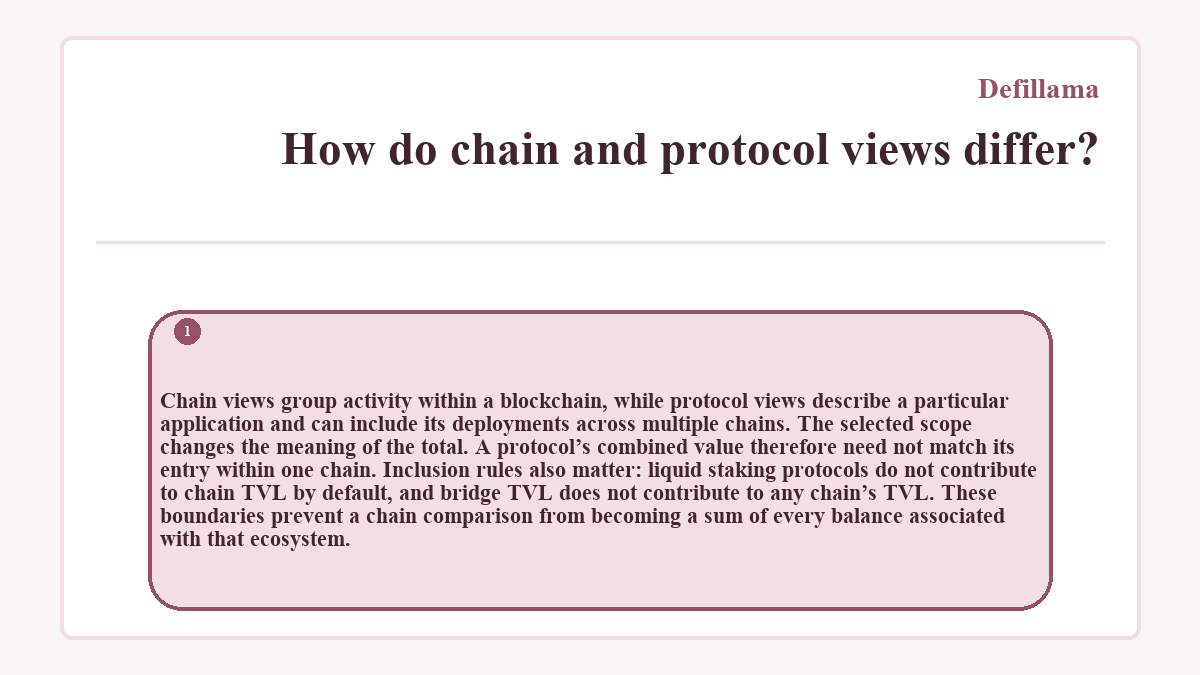
How do chain and protocol views differ?
Chain views group activity within a blockchain, while protocol views describe a particular application and can include its deployments across multiple chains. The selected scope changes the meaning of the total. A protocol’s combined value therefore need not match its entry within one chain. Inclusion rules also matter: liquid staking protocols do not contribute to chain TVL by default, and bridge TVL does not contribute to any chain’s TVL. These boundaries prevent a chain comparison from becoming a sum of every balance associated with that ecosystem.
A revenue comparison with an incomplete record
Consider a hypothetical comparison between two protocol listings: which retains a larger share of the fees its users pay? Before calculating either share, the reader checks that both records cover the same completed period, use the same chain scope and contain fees and revenue. Every listing choice, reporting period and observed data state in this example is hypothetical.
The reader starts with matching protocol categories and compares revenue divided by fees, provided fees are positive. A combined-chain comparison can cover more deployments than a single-chain comparison. The combined-chain ratio describes all included chains; a single-chain ratio describes only the selected chain. Mixing them would change the basis of the comparison.
The reader expects fees and revenue for both listings, but one listing has no revenue value. They remove any calculated ratio for that listing from the comparison while retaining its raw fields. Substituting zero would falsely describe missing data as no revenue.
If revenue becomes available for the matching period and scope, the reader can calculate the ratio and compare the shares. If it remains absent, the completed comparison records the available fees and leaves the revenue comparison unresolved. The saved record marks revenue as unavailable and leaves the protocols unranked.
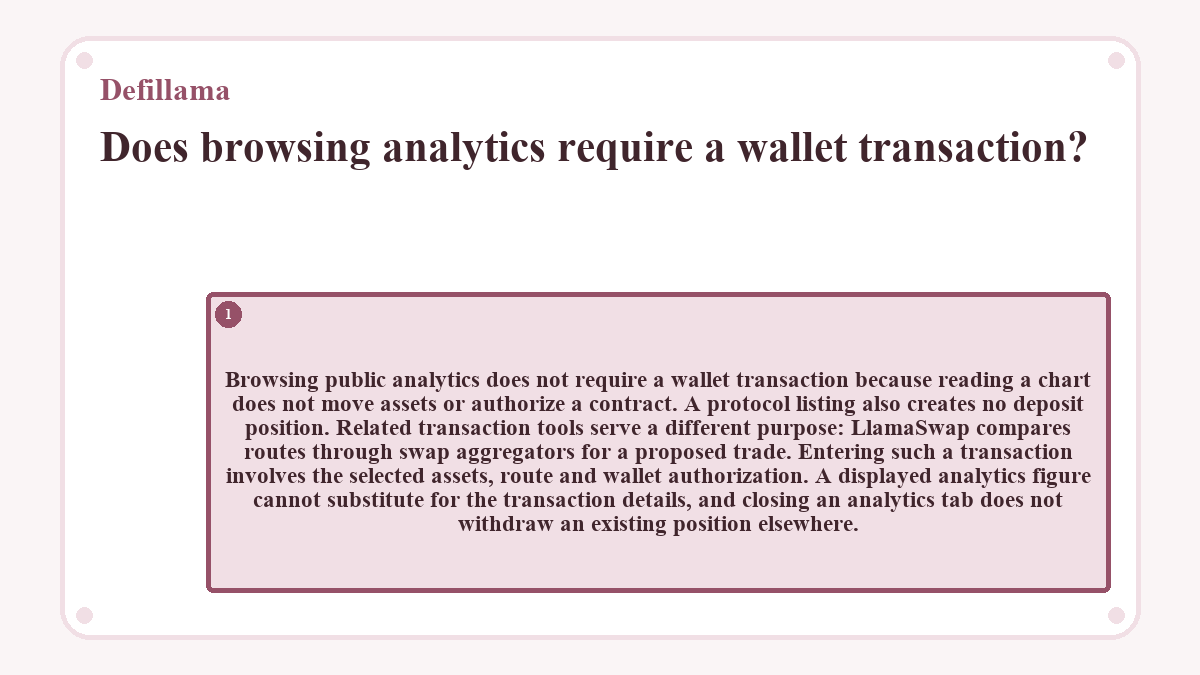
Does browsing analytics require a wallet transaction?
Browsing public analytics does not require a wallet transaction because reading a chart does not move assets or authorize a contract. A protocol listing also creates no deposit position. Related transaction tools serve a different purpose: LlamaSwap compares routes through swap aggregators for a proposed trade. Entering such a transaction involves the selected assets, route and wallet authorization. A displayed analytics figure cannot substitute for the transaction details, and closing an analytics tab does not withdraw an existing position elsewhere.
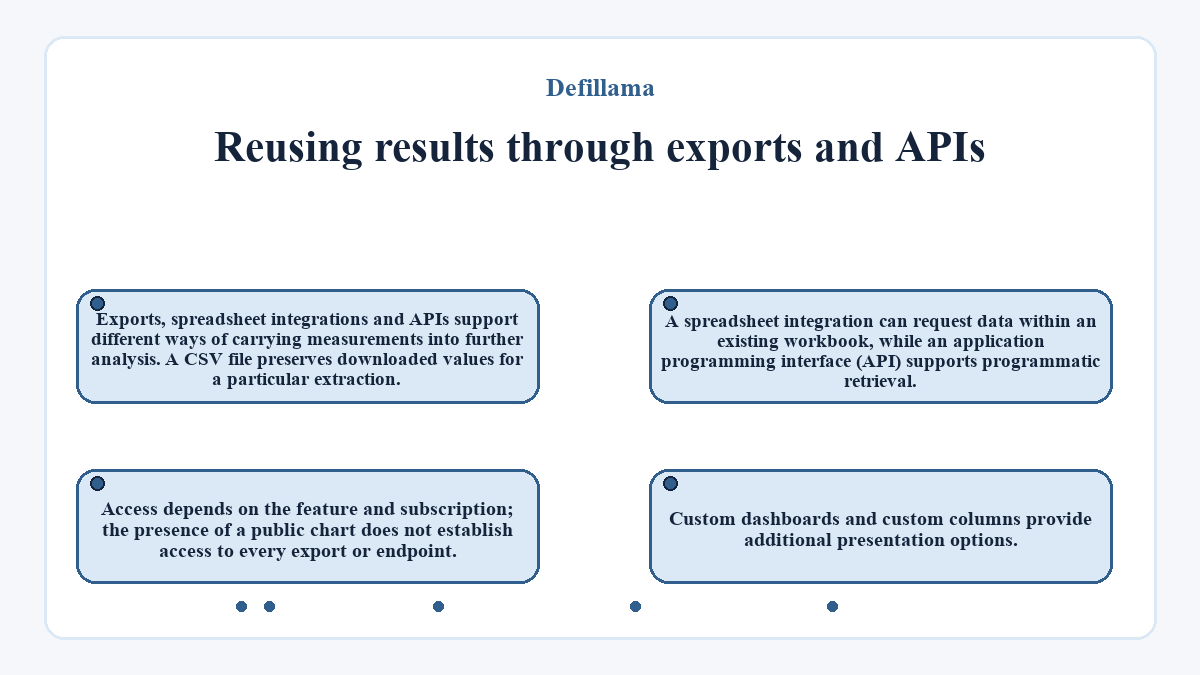
Reusing results through exports and APIs
Exports, spreadsheet integrations and APIs support different ways of carrying measurements into further analysis. A CSV file preserves downloaded values for a particular extraction. A spreadsheet integration can request data within an existing workbook, while an application programming interface (API) supports programmatic retrieval. Custom dashboards and custom columns provide additional presentation options. Access depends on the feature and subscription; the presence of a public chart does not establish access to every export or endpoint.
A reusable record needs the metric name, reporting period, chain scope and measurement time alongside its value. Those details preserve the meaning when a chart or ranking later changes. Missing fields should remain distinct from zeros, and repeated retrievals should not silently mix different periods. Keeping the original values beside any calculation allows another reader to reproduce the comparison or identify precisely which input prevents completion.
Defillama: reader questions
Is Defillama free to browse?
Core analytics are available through a free access tier. Paid subscriptions add features such as custom dashboards, custom columns and spreadsheet integrations. The relevant distinction is the feature required for the task: viewing a public metric, downloading a dataset and retrieving data through a paid API are different access requirements. A subscription price also does not represent a fee charged by a tracked protocol.
How frequently do the measurements update?
Update timing varies by metric and integration. Snapshot measurements such as TVL and stablecoin supply follow an hourly update schedule. Most fees and trading-volume integrations also update hourly, while some update daily. Consequently, neighboring charts can describe different latest periods. The measurement timestamp and whether the reporting period has finished matter more than when the browser tab opened.
Why can an API response differ from the website?
Website caching can leave a displayed value behind an API response. The API receives updated data before the cached webpage refreshes. Comparisons also need matching metric definitions, chain scope and timestamps, since those differences can produce legitimate mismatches. Repeatedly refreshing a page cannot reconcile records measuring different things, and a newer value does not automatically invalidate a saved historical observation.
Does a Pro subscription include paid API access?
The Pro subscription does not include the separate paid API entitlement. Pro covers analytical interface features, while the API subscription adds the relevant programmatic access and includes Pro features. Public endpoints and subscription endpoints also have different access conditions. An integration therefore needs to identify its required endpoint and access tier before treating a browser subscription as sufficient.
Where can a missing protocol or metric be submitted?
Contributors can submit an integration through the repository responsible for the relevant metric. TVL, yields and activity measurements use different adapter collections, so a TVL listing does not automatically supply every other dataset. A submission needs the corresponding implementation and review. Missing coverage alone does not establish that a protocol has no deposits, earns no revenue or has stopped operating.
Are active addresses the same as individual users?
Active addresses measure blockchain addresses rather than verified people. One person can control several addresses, and an address can represent shared activity. The platform’s direct-interaction definition also excludes activity routed through intermediary contracts from that particular measure. An address count therefore needs its stated coverage when used to discuss participation; it cannot establish a precise number of individual users.
Will a listed yield pool have passed a security audit?
A yield listing does not establish that the pool has passed a security audit. The listing reports analytical information rather than certifying the underlying contracts. Audit coverage concerns a particular code version and scope, which a displayed APY or TVL cannot establish. A pool’s earning rate also says nothing by itself about whether withdrawals remain available under its operating conditions.